
Empirio: Learn Business
Deepstash SRLEducation
4.84.00 Reviews
- Version
- 1.11.1
- Installs
- 10.00K
- Age Rating
- Everyone
Screenshots




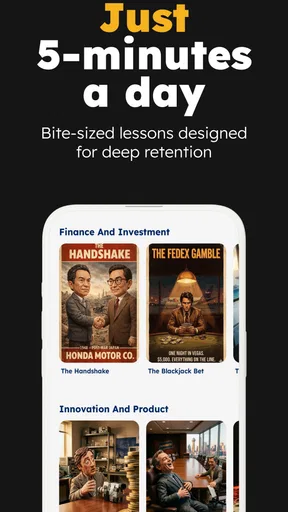
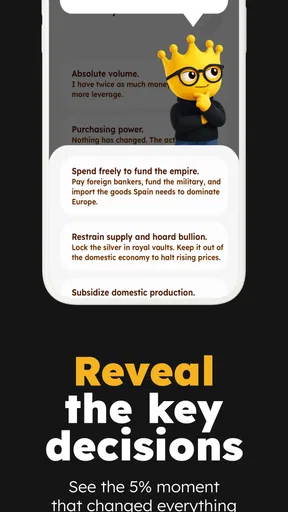


Our Review of Empirio: Learn Business
 Analysis by Appyee
I approached Empirio: Learn Business expecting a compact education app, but its central idea is more active than simply reading explanations. It places business learning inside decisions connected with events that shaped history. That makes it a useful option when I want to think through consequences instead of collecting definitions.
The app is free, aimed at everyone, and comes from Deepstash SRL. It belongs in the education category, although I found its decision-focused format closer to a guided exercise than to a conventional reference tool. Its average rating is 4.8 from around 200 ratings, and it has passed 10K+ installs. The current release is version 1.11.1, while the app requires Android 7.0 or later.
From a vague business question to a practical learning session
I find it helpful to begin with a question I can actually use, such as why a sensible-looking business choice might still carry risk. That gives a session a purpose beyond getting through a scenario and helps me notice which assumptions shape my answer. From there, I can look more closely at how a decision-focused lesson becomes a practical learning routine.
Starting with a real decision rather than a chapter
The strongest part of the experience is the starting condition. Instead of asking me to begin with a long lesson about management, finance, or strategy, Empirio frames learning around choices. That immediately changes how I pay attention. I am not only asking, “What happened?” I am asking, “What would I have done with the information available at that moment?”
That distinction matters for beginners. Business vocabulary can feel abstract when it is presented as a list of terms, but a decision gives each idea a reason to exist. Risk, timing, competition, leadership, and trade-offs become easier to remember when I have to connect them to an outcome.
I also think this starting point suits people who already know the basics but want to sharpen their judgement. A short decision exercise can expose an assumption I normally overlook. I may believe that the safest option is always best, for example, until the historical context shows how delay, limited resources, or a changing market altered the calculation.
A step-by-step flow that encourages active thinking
My useful way to approach a session is to treat each situation as a small case study. First, I read the setup without trying to guess the “correct” answer too quickly. Then I compare the available choices and identify what each one protects or sacrifices. Finally, I use the explanation of the historical outcome to review my reasoning rather than judging myself only by whether I matched it.
This workflow is more valuable than tapping randomly. Before making a choice, I ask myself three questions: what information would matter most, which risk is hardest to reverse, and who benefits from the decision? Those questions turn a quick interaction into a repeatable business-thinking exercise.
A realistic everyday use would be a short evening session after work or study. I could spend a few minutes on one scenario, write down why I selected an option, and then compare that reasoning with the result presented by the app. The next day, I can use the same habit when considering a workplace proposal, a small personal project, or even a purchase where the cheapest choice is not necessarily the best long-term choice.
The historical framing also helps prevent a common learning mistake: treating outcomes as obvious after the fact. When I already know that a decision succeeded or failed, it is easy to imagine that the result was inevitable. Being asked to decide first makes the uncertainty visible. That is one of the app’s less obvious educational strengths.
Why the historical angle changes the lesson
Business education apps often focus on definitions, flashcards, or broad summaries. Those formats are useful when I need to memorize terminology, but they can leave a gap between knowing a concept and recognizing it in practice. Empirio’s historical decision format works in the opposite direction: it gives me a situation first and lets the concept emerge from the choice.
I would not use it as a replacement for a structured business course. It does not offer the same depth as a textbook, lecture series, or formal class. Its value is in creating a bridge between passive knowledge and active judgement. For someone who finds standard lessons dry, that bridge may be the reason business topics finally become memorable.
There is also a useful trade-off here. Historical decisions are engaging because they have a narrative, but a narrative can simplify reality. Real business choices usually involve incomplete information, competing stakeholders, legal constraints, and consequences that unfold over years. I therefore treat the app’s scenarios as thinking prompts, not complete consulting cases.
Handoffs: turning an answer into something I can use
The most important handoff happens between the app and my own reflection. The app supplies the situation and the decision point; I have to carry the lesson into a different context. If I simply select an answer and move on, the experience risks becoming a sequence of small quizzes. If I pause and name the principle behind my choice, the session becomes much more useful.
I recommend keeping a very short note after a scenario: “I chose this because…” followed by one sentence. That creates a personal record of how I evaluate risk and opportunity. After several sessions, the notes can reveal patterns. Perhaps I consistently favor immediate gains, avoid uncertain investments, or underestimate the importance of timing. Those observations are more valuable than a score alone because they show how I think.
A second handoff is useful for students. After completing a scenario, I can explain the decision to a classmate without repeating the app’s wording. If I cannot explain why the choice mattered, I probably understood the story only superficially. This makes Empirio a good starting point for discussion, even when it is used individually.
For a manager or entrepreneur, the handoff can be a team conversation. One person completes a scenario, summarizes the competing options, and asks colleagues which factor they would prioritize. The app does not need to become the whole training program; it can provide a neutral prompt for a broader discussion about strategy and judgement.
The result: what I actually take away
After a session, the main result is not a complete business plan or a professional qualification. It is a clearer sense of how decisions are shaped by context. I come away thinking less in terms of “good choice versus bad choice” and more in terms of objectives, constraints, timing, and consequences.
That is a modest result, but it is realistic and worthwhile. The app is best when I use it regularly enough to build a habit of questioning assumptions. A single scenario may be entertaining; a series of thoughtful sessions can improve the way I approach unfamiliar problems.
I also appreciate that the format can make business history feel less distant. Historical events are often taught as finished stories, with the uncertainty removed. A decision-based approach restores some of that uncertainty and encourages me to see leaders as people making choices with limited visibility, not as characters who already knew the ending.
For a beginner, the result may be increased confidence in discussing business topics. For a more experienced user, it may be a quick mental reset. I would not claim that it can teach advanced accounting, detailed market analysis, or operational execution by itself. Its contribution is narrower: it helps practice the judgement that connects information to action.
Where the flow breaks down
The same simplicity that makes Empirio approachable can limit it. Users looking for long explanations, detailed source material, or a carefully sequenced curriculum may find the experience too light. The decision format gives me a reason to think, but it does not automatically provide the depth needed for serious academic or professional study.
There is also a risk of overvaluing the outcome. Matching a historical decision does not necessarily mean I have better business instincts, and choosing differently does not prove that my reasoning was poor. I have to examine the logic behind the choice. Without that reflection, the app can become a guessing exercise.
Another possible friction is transfer. A decision that made sense in a historical setting may not map neatly onto a modern workplace, startup, or personal budget. I need to separate the underlying principle from the surface details. The useful question is not “Should I copy this decision?” but “What kind of trade-off does this example reveal?”
This is also where other tools may be better. If I need vocabulary practice, a flashcard app is more direct. If I need a complete foundation, an online course or business book will offer greater structure. If I need to analyze a current company, a financial news source or case-study collection will be more relevant. Empirio earns its place between those options by making business learning interactive and historically grounded.
Who should make it part of a routine
I would recommend it to curious beginners, students who learn better through situations, and professionals who want a short way to challenge their assumptions. It is especially suitable for someone who opens educational apps with good intentions but loses interest when the material begins with pages of theory.
It can also work for parents or teachers looking for a conversation starter about business choices. Because the content rating is Everyone, it is presented as broadly accessible rather than restricted to a specialist audience. Still, younger users may need help connecting historical events with modern business language, while experienced users should resist expecting advanced analysis.
I would skip it if my immediate goal is certification preparation, technical finance skills, detailed entrepreneurship planning, or a complete course with assessments and progression. In those situations, its short decision-based approach is better used as a supplement than as the main resource.
How to get more value from each session
My first tip is to delay the choice long enough to identify the real constraint. Many scenarios appear to ask which option is most attractive, but the deeper issue may be timing, resources, reputation, or the ability to recover from failure. Naming that constraint before answering makes the exercise less superficial.
My second tip is to argue for the option I did not choose. After seeing the result, I briefly make the strongest case for the alternative. This prevents me from turning the explanation into a simple victory lap and trains the flexibility that real decisions require.
My third tip is to connect the historical lesson to a current, low-stakes decision. I might compare the scenario’s trade-off with how I plan a study schedule, select a supplier for a small project, or decide whether to invest time in an uncertain opportunity. The comparison should not be literal; it should focus on the reasoning pattern.
Finally, I would use the app in short, focused visits rather than forcing a long study block. Its appeal comes from the quality of the decision, not from spending hours inside it. A small note, a discussion with another person, or a practical example can extend one scenario far beyond the screen.
My final assessment
Empirio: Learn Business is a focused education app with a clear identity. It does not try to be a full business school in miniature. Instead, it uses historical decisions to make business thinking more active, memorable, and approachable.
I like it most when I treat it as a judgement workout: read carefully, choose deliberately, inspect the reasoning, and carry one lesson into a real situation. That workflow gives the app more value than simply tapping through scenarios for entertainment.
My recommendation is straightforward: try it if you want an accessible way to think about strategy and consequences, especially if conventional business lessons lose your attention. Keep another resource beside it when you need technical depth, formal structure, or current market detail. As a free app from Deepstash SRL with an Everyone rating, it is easy to test, and its strongest benefit appears when I use each historical choice as the beginning of a conversation rather than the end of a quiz.
Verdict
Strengths of Empirio: Learn Business
- Short lessons make business topics easy to study in spare moments.
- Covers practical subjects such as marketing, finance, and entrepreneurship.
- Useful for beginners seeking a structured introduction to business concepts.
- Progress tracking helps maintain a consistent learning routine.
- Mobile-friendly format makes studying convenient without a desktop computer.
Limitations of Empirio: Learn Business
- Advanced learners may find the explanations too basic.
- Some lessons may lack the depth of a formal business course.
- Learning value depends heavily on maintaining regular study habits.
- Not a substitute for accredited qualifications or professional training.
- Availability of certain content may depend on the app’s subscription model.
Other Releases by Deepstash SRL
View All
Paladin: Learn History
Education4.5

Dilemmo: Make Better Decisions
Education4.1
Similar Picks in This Category
View All
Duolingo: Language Lessons
Duolingo4.7

Google Classroom
Google LLC2.8

Unacademy: Learn & Crack Exams
Unacademy3.2

Bible App for Kids
Life.Church4.4

Cake - Learn English & Korean
Cake Corp.4.7

Brainly: AI Homework Helper
Brainly4.5
Frequently Asked Questions
What is Empirio: Learn Business, and who is it designed for?
Empirio: Learn Business is an educational app focused on introducing users to essential business concepts through interactive lessons and practical learning activities. It may be useful for beginners, students, aspiring entrepreneurs, and professionals who want to refresh their knowledge. The app is generally more suitable for users looking for accessible explanations than for people seeking an advanced academic or professional business qualification.
What topics can I learn about in Empirio: Learn Business?
The app covers fundamental areas commonly associated with business education, such as entrepreneurship, marketing, finance, management, strategy, and decision-making. Lessons are presented in a simplified format intended to make complex ideas easier to understand. The exact content and depth may vary between sections, so users who need specialized knowledge should treat Empirio as a learning and revision tool rather than a replacement for formal courses, textbooks, or professional advice.
Is Empirio: Learn Business free to download and use?
Empirio: Learn Business can typically be downloaded without an upfront charge, but availability of lessons, features, advertisements, or premium content may depend on the app’s current business model. Before starting, check the store listing for details about in-app purchases, subscriptions, and trial periods. If a subscription is offered, review its renewal terms carefully and manage cancellation through your Google Play or Apple App Store account.
Does Empirio: Learn Business work offline?
Offline access depends on how the app handles its lessons and interactive content. Some material may be available after it has been loaded, while other features could require an active internet connection for synchronization, updates, advertisements, or account access. If you plan to study while traveling, open the app while connected first and test the lessons you need. Also remember that offline progress may not synchronize until you reconnect.
Is Empirio: Learn Business suitable for children or complete beginners?
Empirio: Learn Business may be approachable for complete beginners because business topics are generally introduced in a straightforward, bite-sized format. However, parents should check the app’s age rating, privacy information, advertising practices, and any communication or account features before allowing younger children to use it. The app is best viewed as general educational content, not financial instruction, investment advice, or a substitute for supervised learning.
